Topos-2
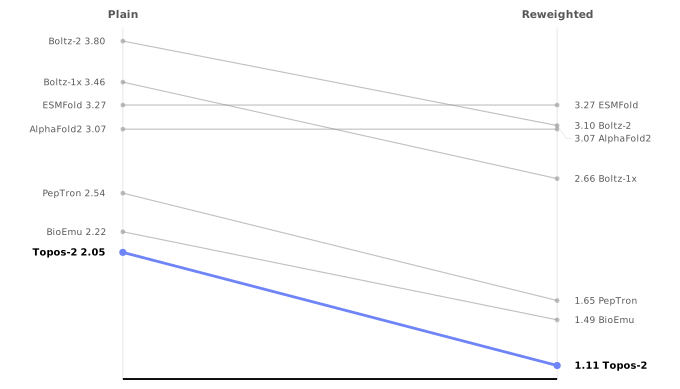
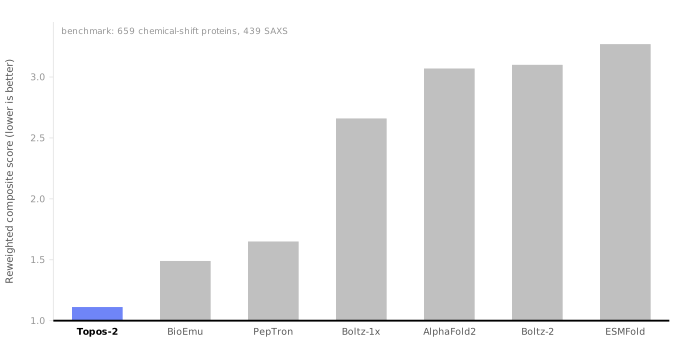
Topos-2 agrees with experiment more closely than any other model on the independent benchmark PeptoneBench. The benchmark evaluates predicted ensembles against both small-angle X-ray scattering (SAXS) and nuclear magnetic resonance (NMR) experiments.
Topos-Bind
We tested Topos-Bind on the Alzheimer’s target amyloid-β, bound to 22 different small molecules. Across these systems, Topos-Bind reproduces the broad distribution of protein shapes seen in all-atom molecular dynamics (MD), while the other evaluated cofolding models collapse the peptide into a much narrower range of conformations.
The majority of proteins contain highly dynamic, intrinsically disordered regions
Intrinsically disordered proteins are not rare. Three out of five human proteins contain disordered regions longer than 30 residues1.
These proteins play critical biological roles in signaling, transcriptional control, and biomolecular condensate formation. The functional importance of these proteins also makes them highly disease relevant. They are implicated in cancer, neurodegenerative diseases, and metabolic disorders.
Despite their ubiquity and high therapeutic importance, the range of shapes these disordered regions adopt - their conformational ensembles - remains difficult to experimentally characterize in atomic detail. Since these proteins lack the stable structures required for structure-based drug design, they have largely been considered “undruggable”.
Introducing Topos-2
Topos-2 is an all-atom generative model that reads an amino acid sequence and generates conformational ensembles. While our first model, Topos-1, modeled disordered proteins and disordered regions, Topos-2 expands on the Topos-1 architecture to generate ensembles across the full order–disorder spectrum. We see its largest gains over existing models on partially and fully disordered proteins.
Topos-2 sets a new state of the art on PeptoneBench
We tested Topos-2 against PeptoneBench2, an independent benchmark composed of NMR chemical shift measurements on 659 proteins and SAXS data on 439 proteins across the order-disorder spectrum3. This data characterizes ensemble properties of the proteins and allows us to compare the quality of model-generated ensembles against experiment. A score near 1.0 represents agreement with the experimental data within the benchmark’s estimated uncertainty, which combines experimental and forward-model error (lower is better). Topos-2 scored 1.11 on the reweighted composite score4, more than four times closer to 1.0 than the next-best model, BioEmu, which scored 1.49. These strong improvements let us illuminate the range of shapes taken by proteins across the order-disorder spectrum, a necessary step to be able to design molecules against proteins long considered undruggable.
Topos-2 is closest to experimental agreement
Previewing Topos-Bind
Topos-Bind is an all-atom generative model that outputs the conformational ensemble of a protein–ligand complex with just a protein sequence and a small molecule’s SMILES string. To our knowledge, Topos-Bind is the first model built to generate conformational ensembles of disordered proteins bound to small molecules.
For a target without a fixed structure, the effect of a small molecule can only be described as a perturbation of the distribution of structures, since the protein is still able to take on many conformations. Amyloid-β, a key target in Alzheimer’s disease, is a clear example.
Monomeric amyloid-β is highly flexible, constantly moving among many different conformations. Some of these conformations are especially prone to self-associate and seed the formation of toxic aggregates, which are hypothesized to be the root cause of Alzheimer’s disease5. Consequently, a therapeutic goal is to shift amyloid-β’s conformational ensemble so that these aggregation-prone states become much less populated, rather than to target a single fixed structure.
We present here a case study of Topos-Bind on amyloid-β. We use all-atom molecular dynamics (MD) from our simulation engine as our reference because physical experiments don’t directly resolve a conformational ensemble.
A precondition for capturing the effects of different ligands on protein ensembles is accurately capturing coarse-grained ensemble properties, such as the radius of gyration (Rg), a measure of how compact or extended a conformation is. Across 22 distinct ligands, Topos-Bind tracks the spread of shapes the peptide takes on, while the other evaluated cofolding models collapse them to a small set of shapes6,3.
Topos-Bind matches the simulated shape spread of ligand-bound Aβ1-42
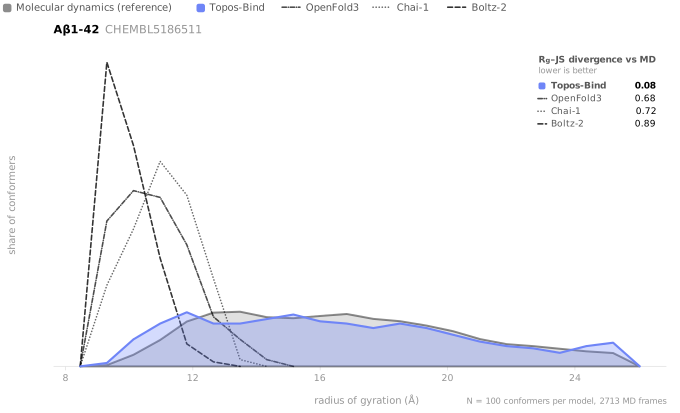
Why do Boltz-2, Chai-1, and OpenFold3 all collapse? That is because these models are primarily designed to output one confident, best-guess shape, not a full range. For amyloid-β, that means each model’s outputs cluster in a narrow range, making them ill-equipped for drug design against dynamic proteins. In contrast, Topos-Bind is designed to model ensembles rather than single structures.
Topos-DB: 100,000 disordered protein–ligand systems
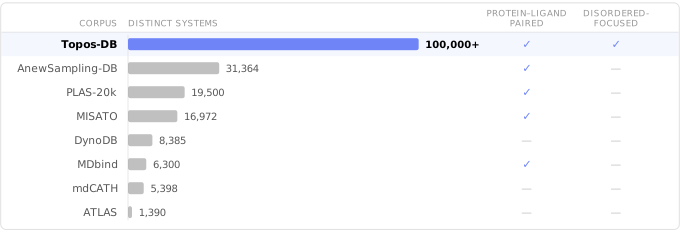
Models of disordered protein–ligand interactions require training data that public structural databases do not provide at scale. We therefore built Topos-DB: more than 100,000 disordered protein–ligand systems simulated with all-atom molecular dynamics using our physics-based simulation engine. To our knowledge, this is the largest all-atom protein MD dataset by distinct system count, at roughly three times the scale of the next largest. This is also the first such dataset to simulate disordered regions with small molecules at scale, as prior public work covers only a handful of single-target case studies.
Topos-DB is the largest all-atom protein MD dataset
From ensembles to drug design
Amyloid-β is not an exception. For disordered and highly dynamic proteins, there is no single structure to design against. To drug them, we need to understand the full range of shapes they can take, and ultimately learn to shift it.
Our platform enables us to generate these protein ensembles, model them together with small molecules, and design compounds that shift proteins away from disease-driving states. Topos-2 and Topos-Bind are key steps towards doing this at scale.
Across our collaborations and internal programs, we are now applying our platform to some of the most devastating “undruggable” targets in human disease.
If your program is limited by protein dynamics, we want to work with you.
Contact us at info@toposbio.ai.
This work would not have been possible without contributions from across the Topos Bio team.
Footnotes
-
Pritišanac, I. et al. A functional map of the human intrinsically disordered proteome. Proc, Natl Acad. Sci. USA 123, e2604562123 (2026). ↩
-
Invernizzi, M. et al. (2025). Advancing protein ensemble predictions across the order–disorder continuum. Preprint at bioRxiv (2025). ↩
-
To prevent data leakage, all benchmark sequences were removed from training, along with any sequence where 80% or more of a benchmark sequence aligned to it at 30% or higher identity. ↩ ↩2
-
Hampel, H. et al. The amyloid-β pathway in Alzheimer’s disease. Mol. Psychiatry 26, 5481-5503 (2021). ↩
-
Across the 22 Aβ1-42 ligand-bound systems, mean Rg for the MD reference is 15.9 Å with standard deviation (SD) 3.2 Å. Topos-Bind has mean Rg of 16.1 Å with SD 4.0 Å, whereas the evaluated cofolding models collapse to mean Rg of 10-12 Å with SD 0.5-1.0 Å. To our knowledge, there are no experimental Rg measurements of ligand-bound Aβ1-42, and so we use all-atom MD as our reference. Measurements for the ligand-free peptide are limited and vary widely (Festa et al., 2019; Heo et al., 2018), though Topos-Bind’s ensembles cover the reported values. ↩
Supplemental Material
Topos-2 scores best both before and after reweighting. It also improves more than other models when reweighted. Reweighting cannot add missing conformations. It can only adjust how often each conformation appears. Topos-2’s large improvement suggests it was already generating experimentally consistent conformations.
Topos-2's ensembles contain the right conformations